Tech
Tech
Idea to Prototype With Cara Code
Idea to Prototype With Cara Code
Idea to Prototype With
Cara Code
A six-hour workshop at ARIS demonstrated how Cara Code can bridge the gap between ideas and working prototypes. Teams used AI to collaboratively shape, plan, and build features, moving from concept to functional prototypes in a single session. The experience highlighted a future where AI helps teams innovate faster, with greater clarity and significantly less friction.
A six-hour workshop at ARIS demonstrated how Cara Code can bridge the gap between ideas and working prototypes. Teams used AI to collaboratively shape, plan, and build features, moving from concept to functional prototypes in a single session. The experience highlighted a future where AI helps teams innovate faster, with greater clarity and significantly less friction.

Ananya Aravinda, Software Engineer
Ananya Aravinda,
Software Engineer
Ananya Aravinda,
Software Engineer
Jul 3, 2026
Jul 3, 2026

Long before AI became part of everyday conversations, ARIS had already begun treating it as a core part of how technology should be built, actively pioneering AI and new tech practices in the industry rather than following examples. Since 2022, the Tech team has been encouraged to question long-standing assumptions and constantly rethink what an efficient development process can actually look like. That mindset of constant experimentation set the stage for an internal workshop designed to explore how AI could participate in reimagining the journey from a concept to a working feature.
Every feature begins with an idea. Converting this idea into a working prototype has always been something teams could imagine easily, but rarely execute quickly. The journey between these two phases goes through several steps- discussions, design, documentation, architecture review, development, feature review and finally, feature in production.
At ARIS, on 28th May, we saw this process happen within 6 hours. We hosted an internal workshop from across the organization to explore what could unfold when our product and engineering teams used Cara Code to take concepts from their earliest stages to their pilot, allowing both perspectives to shape the feature from the beginning. These concepts came in different forms - some as early proposals, some as designs, and each with a different level of scope and complexity.
Very early into the session, it became clear that no two teams were going to use Cara Code the same way. Cara Code was able to understand and help teams move forward with enough structure and clarity.
As the workshop progressed, it became increasingly evident that Cara functioned as more than a passive tool. Rather than simply responding to prompts, it actively contributed ideas, challenged assumptions, and surfaced considerations the teams had not yet explored. This made it feel less like a system waiting for instructions and more like a collaborative partner throughout the process.
Long before AI became part of everyday conversations, ARIS had already begun treating it as a core part of how technology should be built, actively pioneering AI and new tech practices in the industry rather than following examples. Since 2022, the Tech team has been encouraged to question long-standing assumptions and constantly rethink what an efficient development process can actually look like. That mindset of constant experimentation set the stage for an internal workshop designed to explore how AI could participate in reimagining the journey from a concept to a working feature.
Every feature begins with an idea. Converting this idea into a working prototype has always been something teams could imagine easily, but rarely execute quickly. The journey between these two phases goes through several steps- discussions, design, documentation, architecture review, development, feature review and finally, feature in production.
At ARIS, on 28th May, we saw this process happen within 6 hours. We hosted an internal workshop from across the organization to explore what could unfold when our product and engineering teams used Cara Code to take concepts from their earliest stages to their pilot, allowing both perspectives to shape the feature from the beginning. These concepts came in different forms - some as early proposals, some as designs, and each with a different level of scope and complexity.
Very early into the session, it became clear that no two teams were going to use Cara Code the same way. Cara Code was able to understand and help teams move forward with enough structure and clarity.
As the workshop progressed, it became increasingly evident that Cara functioned as more than a passive tool. Rather than simply responding to prompts, it actively contributed ideas, challenged assumptions, and surfaced considerations the teams had not yet explored. This made it feel less like a system waiting for instructions and more like a collaborative partner throughout the process.
“Cara helped turn early ideas to well-formed features, while accounting for complexities from the start.”
“Cara helped turn early ideas to well-formed features, while accounting for complexities from the start.”
“Cara helped turn early ideas to well-formed features, while accounting for complexities from the start.”
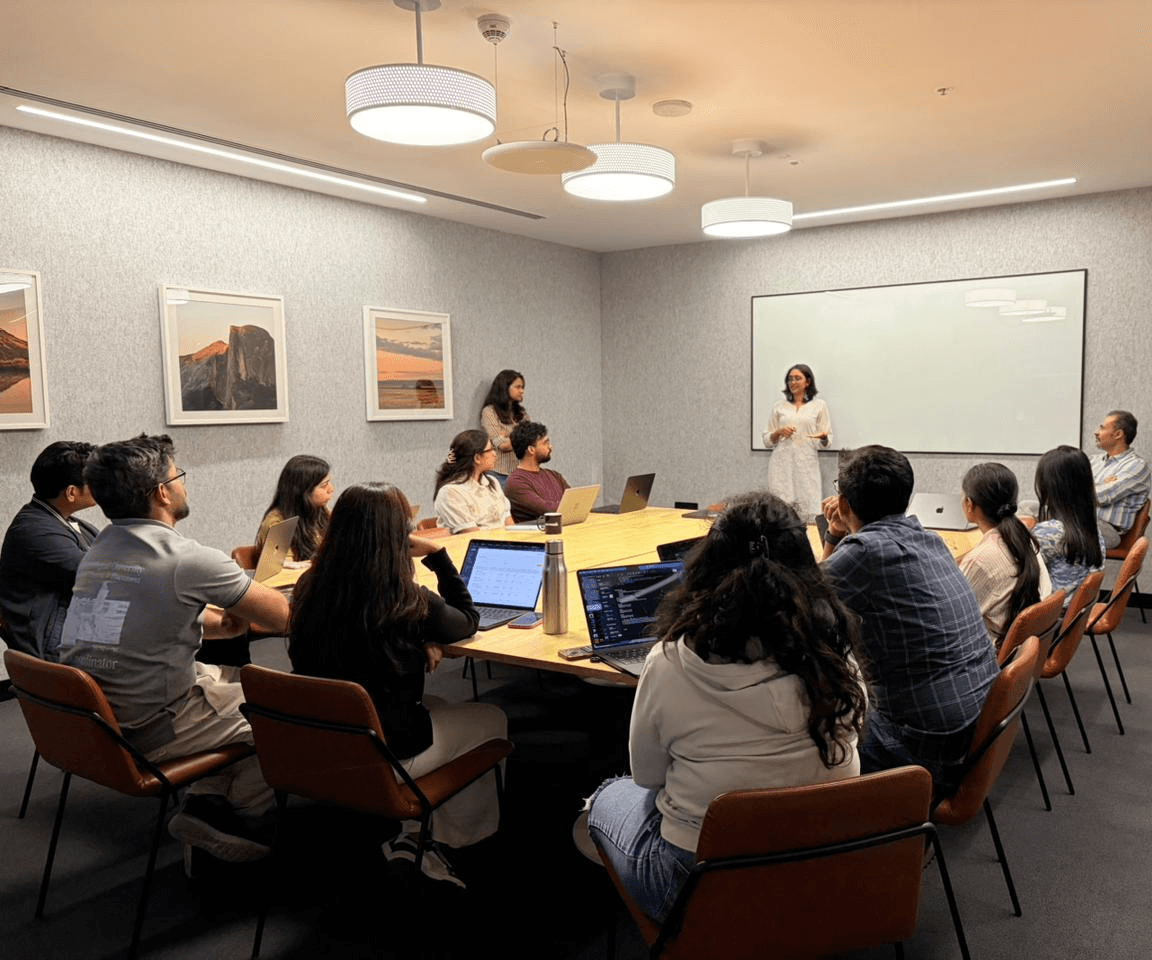
ARIS teams collaborating with Cara Code to transform ideas into working prototypes during the six-hour workshop.
ARIS teams collaborating with Cara Code to transform ideas into working prototypes during the six-hour workshop.
ARIS teams collaborating with CaraCode to transform ideas into working prototypes during the six-hour workshop.
This became especially valuable when feature requests that initially seemed simple, would end up revealing much deeper considerations that had previously been given little to no thought. Cara brought these gaps into the discussion while the feature was in its early stages of being shaped, instead of leaving them to surface as blockers later on.
These conversations helped Cara form a detailed plan and helped refine scope ; capturing not only what needed to be built, but also the ‘Why’ and the ‘How’. These documents produced weren’t just generic summaries. The techies managed to hone their own ideas and deep plans and sought clarifications as required before moving forward. This also allowed the transition to technical planning feel much more natural and connected.
From here, the teams were able to move almost seamlessly into what is commonly the most time-consuming stage of any feature - implementation. Cara’s participation, using the context built from the earlier steps, and its real time feedback and suggestions allowed code to be written in a way that was higher quality and required fewer collaborators than the old school SDLC. As this success settled in, the room shifted from an “ideation mode” to a “review mode”. The shift was subtle, but meaningful. No one was still imagining the future; they were questioning, improving, and testing a concept they had come up with mere hours before.
This became especially valuable when feature requests that initially seemed simple, would end up revealing much deeper considerations that had previously been given little to no thought. Cara brought these gaps into the discussion while the feature was in its early stages of being shaped, instead of leaving them to surface as blockers later on.
These conversations helped Cara form a detailed plan and helped refine scope ; capturing not only what needed to be built, but also the ‘Why’ and the ‘How’. These documents produced weren’t just generic summaries. The techies managed to hone their own ideas and deep plans and sought clarifications as required before moving forward. This also allowed the transition to technical planning feel much more natural and connected.
From here, the teams were able to move almost seamlessly into what is commonly the most time-consuming stage of any feature - implementation. Cara’s participation, using the context built from the earlier steps, and its real time feedback and suggestions allowed code to be written in a way that was higher quality and required fewer collaborators than the old school SDLC. As this success settled in, the room shifted from an “ideation mode” to a “review mode”. The shift was subtle, but meaningful. No one was still imagining the future; they were questioning, improving, and testing a concept they had come up with mere hours before.
By the end of this workshop, most teams were looking at complete and fully working prototypes of their ideas. For a six-hour session that began with proposals, rough ideas, and designs of varying clarity, the outcome was undeniably successful. It demonstrated quite evidently how much faster teams could move when ideation, architecture, implementation and testing were all connected by the same thread.
More than anything, Cara proved to us how the distance between proposal to prototype could be shortened. What sometimes takes days of back and forth across stages was compressed into a matter of hours to generate high quality prototypes.
For ARIS, this workshop was a glimpse into the AI augmented future where features can be brought to life with lower friction and higher ROI than was possible before AI high mainstream.
By the end of this workshop, most teams were looking at complete and fully working prototypes of their ideas. For a six-hour session that began with proposals, rough ideas, and designs of varying clarity, the outcome was undeniably successful. It demonstrated quite evidently how much faster teams could move when ideation, architecture, implementation and testing were all connected by the same thread.
More than anything, Cara proved to us how the distance between proposal to prototype could be shortened. What sometimes takes days of back and forth across stages was compressed into a matter of hours to generate high quality prototypes.
For ARIS, this workshop was a glimpse into the AI augmented future where features can be brought to life with lower friction and higher ROI than was possible before AI high mainstream.
By the end of this workshop, most teams were looking at complete and fully working prototypes of their ideas. For a six-hour session that began with proposals, rough ideas, and designs of varying clarity, the outcome was undeniably successful. It demonstrated quite evidently how much faster teams could move when ideation, architecture, implementation and testing were all connected by the same thread.
More than anything, Cara proved to us how the distance between proposal to prototype could be shortened. What sometimes takes days of back and forth across stages was compressed into a matter of hours to generate high quality prototypes.
For ARIS, this workshop was a glimpse into the AI augmented future where features can be brought to life with lower friction and higher ROI than was possible before AI high mainstream.
Partner With Us
From supply to execution, we make construction
simple, reliable, and scalable.
Contact Us
© 2025, Arisinfra Solutions Limited. All Rights Reserved.
Partner With Us
From supply to execution, we make construction simple, reliable, and scalable.
Contact Us
© 2025, Arisinfra Solutions Limited. All Rights Reserved.